
The Wager by David Grann is a Master Class in Historical Non-Fiction
This is a dramatic statement, but it’s true.
*This review, although it’s about three hundred-year-old events, contains no spoilers and only includes elements detailed in Grann’s description*
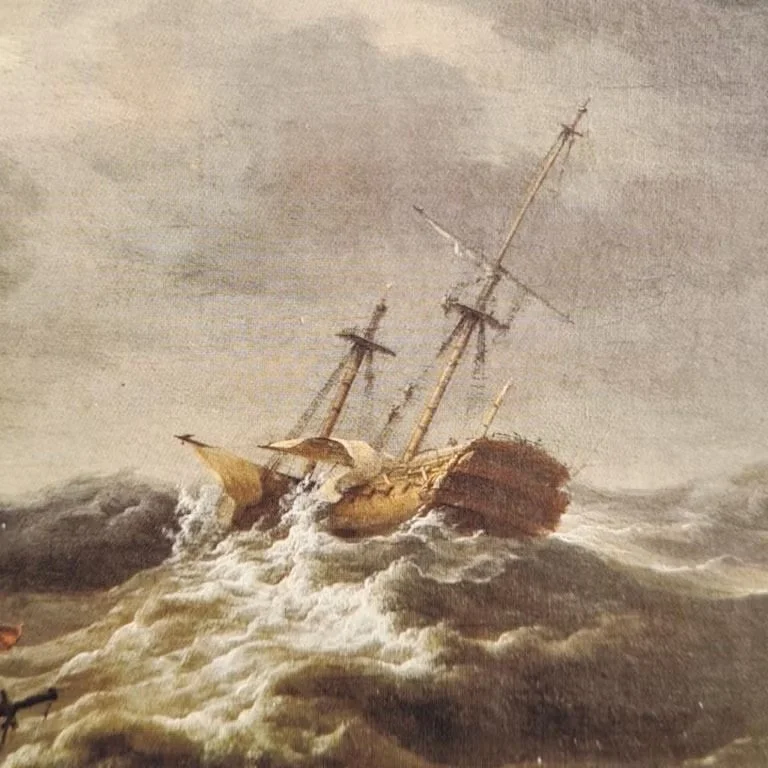
“The ‘Wager’ in Extremis',” Charles Brooking, c. 1744. Image: Collection of the late Commander David Joel.
I fully expected this book to end up with the rest of my non-fiction - half-read on a shelf in my living room, to be perpetually almost read but never donated, in a vicious cycle. Non-fiction, especially historical accounts or bibliographies, make me feel as if I’m studying. Sometimes I love it, most of the time I can’t make myself do it. And I know if I try to force myself to read a book I’m not enjoying, I’ll be in a slump for months. Especially during and after graduate school which required innumerable reading assignments.
Not to mention that reading is an escape for me. Anything involving politics, even if it’s 1700’s Great Britain, makes my skin crawl. Capitalism, war, government cover-ups, they’re all interesting if there is a degree of removal - a fictional spin or a fantasy world, one where I’m not affected. But when it’s current or still relevant (as all history should be), I reach for something else every time. As someone who likes to stay informed and up-to-date with current events, when I read, I’m thinking “(mentally) get me out of here.”
The Wager: A Tale of Shipwreck, Mutiny, and Murder was entirely different. I grew up loving maritime shows, shipwrecks, and especially survival stories. Pirates of the Caribbean: Curse of the Black Pearl will always be considered perfection in my eyes. Castaway was a foundational film for me. My dad always loved Oak Island and Greatest Catch. Something about The Wager catered to this neglected interest, and I had already heard nothing but praise for it. Within days of diving in, I was finishing the novel in complete awe. How was that real?
Nothing about The Wager feels non-fiction. This book feels as if I pulled it from my thriller shelf between “The Troop” and “And Then There Were None.” Start to finish, my jaw was on the floor. I knew Pirates of the Caribbean and even Castaway were romanticized to a degree (obviously). But what I didn’t expect is how less dramatic they were in comparison to what unfolded on Wager Island. Nick Cage’s solitude, it seems, was an act of divine mercy.
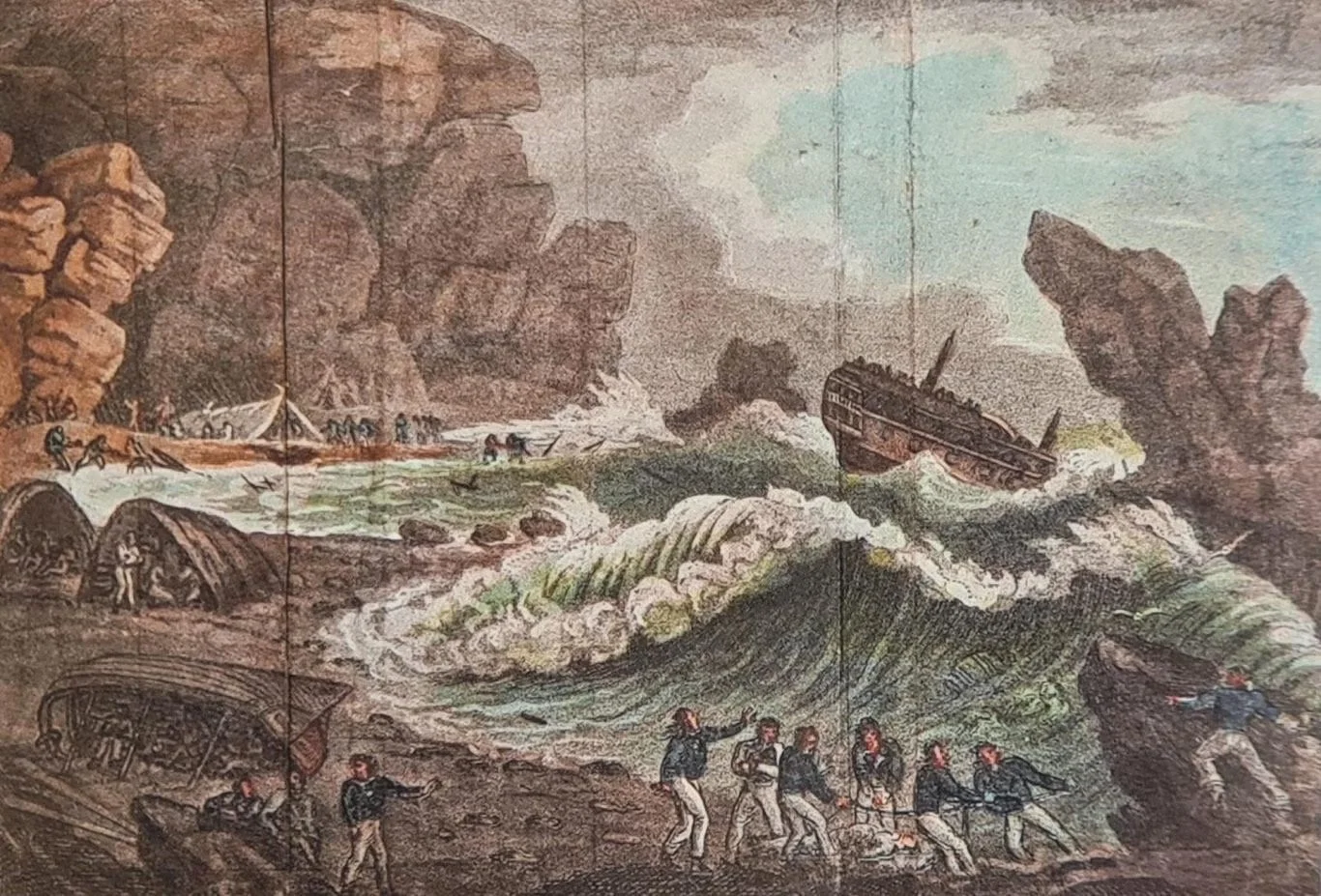
Engraved depiction of the survivors building their shelters and encampment on Wager Island. Image: From “The Loss of Wager Man of War, one of Commodore Anson’s Squadron…and the Embarrassments of the Crew, Separation, Mutinous Disposition, Narrow Escapes, Imprisonment and Other Distresses,” 1768. Photo © Michael Blyth.
In short, with no spoilers: The Wager was a man-of-war ship in Great Britain during the Battle of Jenkins Ear, setting off for Spain in the 1740’s as part of a larger fleet with an unusual mission. After what seemed to be a thousand bad omens and a cursed affair from the start, the ship wrecked in 1741 on what is now known as Wager Island off the coast of western Patagonia - desolate and uninhabited, with a brutal climate. The surviving crew navigate their starving comrades, diseases, and the once-preserved naval hierarchy begins to crumble. The crew turned on each other as if in “Lord of the Flies.” In 1742, a ship arrived off the coast of Rio Grande, built from the wreckage of the original ship. These men announced themselves as the survivors of The Wager, were celebrated and hailed as heroes, and went home to Great Britain to tell their incredible story of self-preservation and survival. That is, until four years later in 1746 when a second boat crafted from the wreckage docked in Dover, containing the captain of The Wager and two other survivors, who contradicted the entire accounts of the initial survivors and outed them as mutineers. A court martial convened to determine who was telling the truth - and who would be hung for treason and mutiny.
Grann’s presentation was balanced and informative. I fully understood both groups of men, and their conflicting narratives somehow both called for compassion and empathy. When you turn to the back of the book, you see an arsenal of sources and citations. Grann spent five years combing through documents and historical texts, and the reader feels the benefit of that - a writer committed to what actually happened. The logbooks (which miraculously survived) provided substantially different accounts of the events, while somehow telling the same story. In a 2023 interview with Tufts Now, Grann talks about the lies we tell ourselves, and how we justify our behavior no matter how much it manipulates the story.
David Grann, A Shipwreck Tale for the Ages, Taylor McNeil, TuftsNow, April 18, 2023, https://now.tufts.edu/2023/04/18/shipwreck-tale-ages.
When asked for an example of a blatant difference in narrative, Grann provided: “The most glaring example of this is when in one account, the senior officer says, ‘I was forced to proceed to extremities on the island.’ And then of course, you pick up the other account by John Byron, who says, ‘He shot him right in the head, and I had to hold my friend as he was bleeding out.’” Id.

The story I found within The Wager is one of betrayal, and the power of the human mind and body when put in conditions as vile and incompatible with life as these men. Empirical preservation hinges on the stories they tell - but even more-so on the stories they don’t. If you hadn’t previously heard of The Wager or its famous survivors (one being the grandfather of the classic poet Lord Byron), it is entirely by design.
I decided to annotate this book before starting. The topics I choose to mark were:
human nature under pressure;
shipwreck and survival;
maritime crime and legal specifics;
initial mission and purpose; and
conflicting accounts
My annotation style is purely for myself. It helps me remember the material, and flip back to certain points when I want to show someone a certain quote.
I can’t recommend picking up The Wager enough. It completely shifted my perspective on life during these brutal wars, the gruesome conquests and battles for national expansion. You by no means need to be a history buff to become enraptured in this story.
“We all impose some coherence—some meaning—on the chaotic events of our existence. We rummage through the raw images of our memories, selecting, burnishing, erasing. We emerge as the heroes of our stories, allowing us to live with what we have done—or haven’t done.” The Wager, Prelude, p.5.